

Your Sensei doesn't need another mass-produced shinai; they need to know you finally understand that the sword never actually stays in the dojo. It's a heavy realization. You've spent countless hours sweating through suburi, absorbing the weight of their corrections, and learning that kendo philosophy for daily life is about more than just a physical strike. It's about fudoshin, the immovable mind, and the relentless discipline required to maintain it. You've seen the 19th World Kendo Championships in Milan come and go, proving that this path is a global, lifelong obsession rather than a casual hobby.
You likely worry about offering a gift that feels shallow or fails to respect the gravity of their sacrifice. We understand the grind, the early mornings, and the quiet pride of a life defined by the blade. Discover how to bridge the gap between ancient kendo tenets and modern appreciation with gifts that honor a Sensei's lifelong dedication. You'll learn how to respect traditional etiquette and find items that signal a deep, shared understanding of the path. This guide ensures your gratitude reflects the reality that for a true practitioner, kendo is life.
Key Takeaways
- Learn why generic coaching gifts fall short of the deep bond found in Budo. You'll understand how to select a token that truly honors a lifetime of discipline and sacrifice.
- Discover how to apply kendo philosophy for daily life when choosing a gift that embodies principles like Ki-Ken-Tai-Ichi. You'll find items that represent the internal discipline required for mastery.
- Explore the power of identity-driven apparel that lets a teacher wear their commitment. It's about moving beyond the bogu to declare that kendo is a life-defining pursuit rather than a simple hobby.
- Master the nuances of Reiho and traditional gift-giving timing. You'll learn the proper way to present your gratitude through the customs of O-seibo and O-chugen to ensure your respect is felt.
- Find a curated selection of items that bridge the gap between ancient tenets and the modern grind. These choices honor a Sensei's personal identity and their role as a guardian of the art.
The Challenge of Honoring a Sensei: Why Ordinary Gifts Fall Short
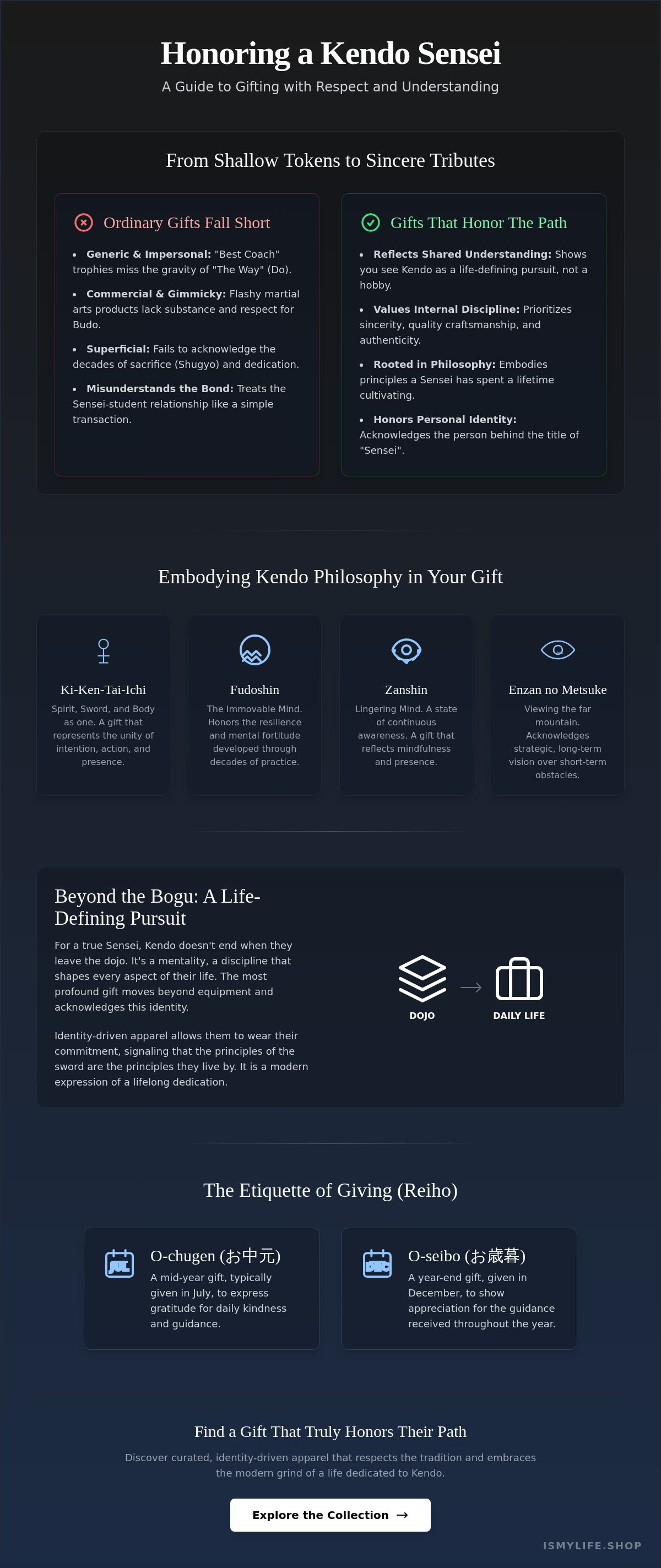
In the dojo, the air carries more than the scent of old indigo and cedar. It carries the weight of a lineage. The relationship between a student and a Sensei isn't a simple business transaction. It's a bond forged in the heat of mutual struggle, defined by thousands of repetitive strikes and the quiet patience of a teacher who sees your potential before you do. When you seek to honor this connection, a generic "Best Coach" trophy feels hollow. It lacks the gravity of the "Do." It fails to acknowledge that Kendo philosophy isn't a seasonal sport; it's a life-defining commitment.
Choosing a gift requires you to move past the superficial. You're no longer a casual observer. You're a dedicated practitioner. This transition means understanding that every gesture should reflect the path you walk together. A Sensei doesn't just teach you how to hit a target. They teach you how to exist. Integrating kendo philosophy for daily life means your gratitude must be as sharp and intentional as a well-timed men-uchi. If the gift doesn't signal a deep understanding of their discipline, it risks feeling like a shallow afterthought.
Understanding the Sensei's Dedication
Behind every correction lies decades of shugyo. This austere training represents a lifetime of early mornings, bruised limbs, and mental fortitude. Your Sensei is a mentor who has sacrificed years to the grind of mastery. Recognizing this effort is the first step in choosing a meaningful token. A thoughtful gift must mirror the seriousness of their commitment. It acknowledges that they aren't just an instructor you see twice a week, but a guardian of an ancient tradition who has chosen to share that weight with you.
The Pitfalls of Commercial Gifting
The market is saturated with gimmicky martial arts products that prioritize flash over substance. Avoid them. There is a fundamental difference between "sports" equipment and Budo tokens. One is a tool for a game; the other is a symbol of a lifestyle. When selecting a gift, prioritize:
- Quality of craftsmanship.
- Sincerity of the intent.
- Persistence of the message.
- Authenticity of the materials.
Core Kendo Philosophy: Lessons That Transcend the Dojo
The dojo is not a cage. It is a forge where identity is hammered into shape. When a Sensei steps onto the floor, they are manifesting a worldview that encompasses kendo philosophy for daily life. The Core Kendo Philosophy defines the practice as a way to discipline the human character through the application of the principles of the Katana. This isn't abstract theory. It is a visceral reality that dictates how one faces a boardroom, a family crisis, or a personal failure.
Ki-Ken-Tai-Ichi represents the essential unity of spirit, sword, and body. In the context of kendo philosophy for daily life, this means your intentions must match your actions and your physical presence. There is no room for hesitation. If your spirit is elsewhere while your body works, the strike is hollow. This same focus defines Fudoshin. An immovable mind does not mean a cold mind. It means a mind that remains steady when the world tries to shake it. Whether facing a competitive opponent or a high-stakes deadline, the Sensei remains centered. Kizeme adds to this by exerting mental pressure and presence. It is the quiet authority of someone who has mastered themselves, commanding the space before a single word is spoken.
Applying Kendo Tenets to the 'Real' World
Resilience is the modern translation of Fudoshin. It is the ability to absorb impact and remain functional under stress. Practitioners also utilize Enzan no metsuke, or looking at the far mountain. Instead of fixating on the immediate obstacle, you maintain a wide view of the entire horizon. This prevents tunnel vision and allows for strategic movement in both business and personal growth. Zanshin is a lifestyle of continuous mindfulness that refuses to relax until the objective is truly secured.
Kendo as a Lifetime Manifesto
For those who have committed decades to the floor, the grind never truly ends. Every repetitive suburi is a metaphor for the persistence required to excel in any field. This obsession transforms a pursuit into an essence. It is why many choose to wear their commitment through passion-driven apparel that reflects their internal reality. They don't take a day off from who they are. If you want to honor that dedication, consider a Kendo Is My Life T-Shirt that speaks their truth outside the dojo walls.
The 'Is My Life' Mentality: Why Identity-Driven Apparel Matters
Kendo is not a hobby. It's a transformation. When the bogu is packed away and the sweat dries, the spirit of the kendoka remains. This is where identity-driven apparel bridges the gap. It's about moving beyond the mats to wear your truth in the open. A Sensei, having spent decades in the grind, appreciates when their lifelong obsession is recognized as more than just a sport. It's a recognition of their essence. This is the ultimate expression of kendo philosophy for daily life. By choosing a gift that speaks this language, you acknowledge that their commitment doesn't have an "off" switch. You're honoring the person they've become through the sword.
A simple, intense declaration of one's life work carries immense power. For a teacher who has weathered countless strikes and guided hundreds of students, a gift that mirrors their internal fire is deeply resonant. It's not about fashion. It's about belonging. It's about the early hours, the repetitive motions, and the quiet pride of persistence. Understanding The Etiquette of Giving means recognizing that the most respectful token is one that aligns with the recipient's soul. High-quality apparel serves as a modern uniform for those who view their discipline as a core part of their being.
Clothing as a Philosophy Statement
Modern passion-driven apparel serves as a contemporary 'mon' or family crest. It signals a shift from being someone who merely attends practice to becoming a true kendoka. The Kendo Is My Life T-Shirt resonates with the Budo spirit because it doesn't apologize for its intensity. It's a focused, rugged statement that mirrors the singular devotion required to achieve high rank. It tells the world that the wearer's values are rooted in the dojo, even when they're navigating the complexities of the outside world.
Quality and Craftsmanship in Apparel
A Sensei values longevity. They've spent years maintaining their gear, and they expect the same durability from their daily wardrobe. Choosing apparel with minimalist designs reflects the Zen influence central to kendo. It's clean. It's purposeful. It's direct. Look for items that:
- Utilize heavy-duty, reliable fabrics.
- Feature timeless, uncluttered aesthetics.
- Reflect the internal discipline of the wearer.
- Stand up to the rigors of a busy, active routine.
Roundup: Top Thoughtful Gifts for a Kendo Sensei in 2026
The right gift doesn't just sit on a shelf. It breathes with the recipient. In 2026, the global kendo community is more connected than ever, yet the core requirement for a student remains unchanged: showing that you recognize the Sensei’s path as a total existence. Choosing an item that embodies kendo philosophy for daily life means looking for quality that matches their grit. Whether it's a small token of respect or a significant group gift, the intent must be unmistakable. Finding a gift that aligns with kendo philosophy for daily life ensures your gesture carries the weight of a true kendoka.
Personal Identity Gifts
The Kendo Is My Life T-Shirt stands as the ultimate acknowledgment of their tireless devotion. It's a bold, minimalist statement that transitions their identity from the dojo floor to the streets. For a more traditional touch, a custom-ordered tenugui featuring hand-painted calligraphy, currently available for $65.16, offers a functional piece of art they can use during every practice. These items serve as an "off-duty" uniform, signaling to the world that their Budo spirit is never dormant.
Practical and Traditional Tokens
Meticulous practitioners value tools that preserve the art. Premium shinai maintenance kits are essential for safety and longevity. For a Sensei who appreciates dojo aesthetics, a miniature shinai display set, priced at approximately CAD 60.00, serves as a dignified reminder of their role as a teacher. Other thoughtful options include:
- High-end cedar bogu deodorizers for equipment longevity.
- Specialized 100% cotton kendogi jackets, available for $48.99.
- Books on kendo history that invite deep reflection during quiet hours.
- Personalized acrylic ornaments, priced around $27.59, for their desk or home office.
The Gift of Experience and Respect
Sometimes the most profound respect is shown through action. Donating to the dojo’s equipment fund in the Sensei’s name helps ensure the next generation has the tools they need. Organizing a Godo-Keiko, or joint practice, brings the community together to celebrate their leadership and sacrifice. Above all, a hand-written letter expressing how their guidance has shaped your character is often the most valued gift a teacher can receive because it validates their life's work. It provides the emotional fuel they need to keep pushing through the grind.
Shop the Kendo Is My Life collection to find a gift that honors their lifelong dedication.
The Etiquette of Giving: How to Present Your Token of Gratitude
Reiho is not just a set of rules for the dojo floor. It's the beginning and end of every meaningful interaction in the world of Budo. When you present a gift to your Sensei, you aren't just handing over an object. You're performing a ritual of respect that validates your shared years of sweat and struggle. In Japanese tradition, timing is everything. Practitioners often look to O-seibo (year-end) or O-chugen (mid-year) as the appropriate windows for these tokens. This disciplined approach to gratitude is a core component of kendo philosophy for daily life, ensuring that your actions outside the dojo remain as sharp and intentional as your strikes within it.
The concept of Giri, or moral duty, defines the student-teacher bond. It's a heavy, beautiful obligation. You're acknowledging the debt of gratitude you owe to the person who has guided your obsession. This isn't about a casual "thank you." It's about recognizing the grit required to lead others toward mastery. By following traditional etiquette, you demonstrate that the lessons have taken root in your character. You prove that you understand the weight of the tradition you've been invited to join.
The Ritual of the Presentation
Always use both hands. This physical gesture signals that the gift carries the full weight of your respect. It's a sign of modesty and focus that is fundamental to the art. During the exchange, a proper bow (ojigi) is essential. The depth of your bow should reflect the seniority and dedication of your Sensei. Avoid flashy or disruptive presentations in the middle of a busy dojo session. Wait for a quiet moment after practice when the atmosphere is calm and focused. This ensures the exchange remains a private, sincere moment of connection rather than a public spectacle.
What to Say: Expressing the 'Way'
Your words should be as minimalist and powerful as a single kote strike. Focus on the impact the Sensei has had on your life. Use the phrase "Osewa ni narimashita" to acknowledge the care and instruction they've provided. This isn't just about kendo; it's about the internal discipline you've cultivated under their watch. Closing the loop means explaining how the gift represents your shared commitment to the grind. You're telling them that you're still on the path, still pushing, and still grateful for the light they provide. Integrating kendo philosophy for daily life transforms a simple gift into a manifesto of continued devotion.
Walk the Path Beyond the Dojo Walls
The sword is a mirror reflecting a lifetime of internal discipline. You've seen how a truly thoughtful gift moves past the superficial to honor the shugyo and sacrifice your Sensei embodies. By integrating kendo philosophy for daily life, you recognize that the lessons of the dojo are meant to be lived every single hour. Whether you choose a traditional token or a modern statement of identity, your gesture must mirror the intensity of their commitment. Remember that the ritual of presentation is your final strike; it's a physical manifestation of the respect you've cultivated through years of sweat.
It's time to bridge the gap between ancient tenets and modern reality. Our identity-driven designs are crafted for the truly dedicated, utilizing high-quality fabric that stands up to the daily wear of a focused life. We provide worldwide shipping for global dojos to ensure every practitioner can wear their truth regardless of where they train. Honor your Sensei's legacy with the Kendo Is My Life T-Shirt and acknowledge the path they walk. Keep pushing. Keep striking. Your continued dedication is the ultimate tribute to their teaching.
Frequently Asked Questions
What is the most traditional gift for a kendo Sensei?
Traditionally, high-quality tenugui featuring meaningful calligraphy or premium sake are considered the standard tokens of gratitude. These items respect the history of the art and the teacher's role as a cultural guardian. You aren't just buying a towel; you're offering a tool for their daily practice. Focus on craftsmanship that mirrors their own dedication to the sword and the grind of mastery.
Is it appropriate to give a kendo Sensei a t-shirt?
It is appropriate when the apparel serves as a modern manifesto of their identity outside the dojo. A high-quality Kendo Is My Life T-Shirt acknowledges that their commitment doesn't end when they remove their bogu. It's a rugged, focused statement that resonates with the Budo spirit. This type of gift becomes a dedicated uniform for their daily routine and personal time.
How much should I spend on a gift for my kendo teacher?
The value of the gift lies in the sincerity of the intent rather than the dollar amount. Quality should always be the priority. A Sensei respects the persistence and effort required to find something meaningful. Whether it's a small personal token or a larger group contribution, ensure it reflects the gravity of the path you walk together and the time they've invested in your growth.
When is the best time to present a gift to a Sensei?
Presentation usually aligns with the Japanese traditions of O-seibo at the end of the year or O-chugen in the summer. These windows provide a disciplined structure for expressing gratitude. If you've reached a personal milestone or finished a significant seminar, that transition also serves as a respectful time to offer a token of appreciation. Timing should feel purposeful and never rushed or accidental.
Should a kendo gift be given individually or from the whole dojo?
Individual gifts are suitable for personal milestones, but group gifts from the entire dojo often carry a more significant impact for high-ranking Sensei. It demonstrates a unified spirit among the students. This collective gratitude mirrors the shared struggle of the dojo. It reinforces the bond between the teacher and the community they've built through years of hard work and repetitive training.
What should I avoid when buying a gift for a kendo practitioner?
Avoid low-quality, gimmicky martial arts novelties that prioritize flash over substance. These items often feel disrespectful to the serious nature of the art. Stay away from generic sports gear that doesn't acknowledge the specific weight of Budo. If the item feels like a shallow afterthought, it fails to honor the kendo philosophy for daily life that your Sensei expects you to embody.
How does kendo philosophy influence the choice of a gift?
Kendo philosophy for daily life dictates that every action should be intentional, focused, and respectful. Your gift choice should reflect principles like Fudoshin, the immovable mind, or Zanshin, the state of continuous awareness. Look for items that suggest longevity, internal discipline, and a no-nonsense attitude toward passion. The gift should be a physical extension of the mental state required for lifelong mastery of the blade.
What does 'Rei' mean in the context of gifting?
Rei translates to respect or etiquette, but it represents the soul of every interaction in kendo. In gifting, it means the act is performed with total focus and humility. It's about the two-handed presentation, the depth of the bow, and the sincerity of the words used. Rei ensures that the transaction is a moment of mutual recognition rather than a simple exchange of goods or services.